Plain Concepts
We are a global IT professional services company
Introduction

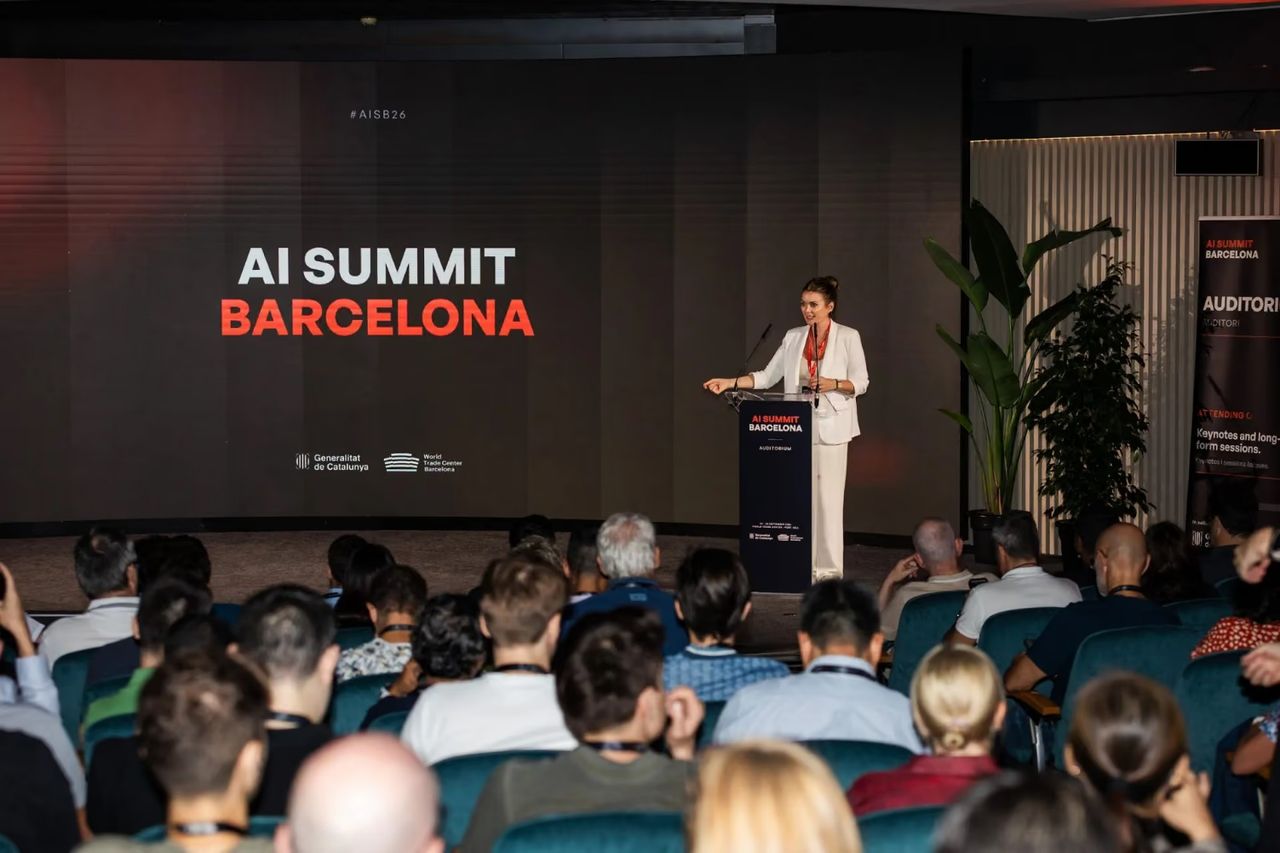
On September 22 and 23, the World Trade Center hosted AI Summit Barcelona 2026, an event with more than 200 speakers and a programme that combined keynotes, panels, workshops and demos on artificial intelligence.
Plain Concepts attended through our colleague Kevin Albes, Principal AI Engineer. Over the two days, the event brought together technical and business perspectives on AI adoption, from application evaluation and cybersecurity to autonomous agents, team transformation and European technological sovereignty.
Here are the sessions from the programme we found most interesting.
Day 1 recap, September 22
On day 1, the sessions covered:
Albert Tort and Maria Galindo took part in the opening, which framed the event within the Catalunya IA 2030 strategy. Approved in November 2025, this roadmap plans to mobilise 1 billion euros by 2030 and links technological development with its adoption by companies and public administrations.
Chema Alonso, Vice President and Head of International Business Development at Cloudflare, explained how AI is changing vulnerability detection and security testing in Hacking and Cybersecurity in the age of AI.
His talk also focused on the risks: the capabilities of these systems are advancing faster than the mechanisms to control them. Data leaks, model manipulation and incorrect answers are among the problems organisations need to consider when deploying these tools.
The technical programme included a demo by Ilyass El Mansouri, Head of Forward Deployed Engineering for EMEA at OpenAI. The session on an AI application for tax showed how to turn production usage traces into evaluations and use agents to convert detected failures into verifiable improvements.
What makes the case interesting is the application’s improvement loop: observing how it behaves, identifying errors and checking whether changes fix them. This matters most when a tool moves from a demo to handling real-world situations.
Julia Hernandez, Applied AI Architect on Anthropic’s founding team in Spain, joined Cathy White in a conversation about enterprise deployment of Claude and the company’s plans for the Spanish ecosystem. Both sessions brought the discussion about models closer to the work needed to build them into products and processes.
Day one also made room for workshops. In The Human Side of AI Transformation, Roberta Scrofani, founder of Elevate, proposed approaching adoption through people’s behaviour.
The workshop connected technology training with capabilities such as judgement, attention, trust and autonomy. Its programme drew on research and interviews to explore how ways of working change when AI tools are introduced.
This perspective helps place training within organisational transformation. Learning to use a tool is one part of the process; deciding how to bring it into everyday work also means rethinking habits and responsibilities.
Rodrigo Aramayo, VP Data at Wallapop, and Kevin Kahn, CEO and co-founder of Albatross AI, presented a case on product discovery with perception models. The session tackled a challenge typical of marketplaces: recommending unique items in a catalogue that changes constantly, even when new listings have no interaction history yet.
Albatross’s approach uses user behaviour during browsing to interpret intent and adapt recommendations as the session progresses. The collaboration with Wallapop served to explain how to apply this approach to product discovery.
Our colleague Kevin Albes highlighted this talk as a chance to see how Wallapop handles recommendations, one of the topics he found most interesting at the event.
Jesús Barrasa, AI Field CTO at Neo4j, presented The Knowledge Layer: Thinner Agents on a Smarter Substrate. The session covered how to represent enterprise knowledge with graphs that connect data, business concepts and relationships, and make that information available to agents.
The idea is to organise that context in a shared layer, so agents can retrieve relevant information and traverse the connections between data. Through examples and customer cases, the talk explored how a layer built on Neo4j can help produce better-grounded, explainable results.
Kevin Albes also named this session among his favourites, especially for its explanation of the knowledge layer and of how to represent knowledge with graphs in Neo4j.
In the afternoon, the panel Retail Rewired: AI from Storefront to Checkout brought together Neel Arora from Nestlé, Marc Torrent from Bonpreu and Arnaud Sliwa-Biset, moderated by Bhavishya Ramchander.
Arora noted that the obstacles to scaling AI usually have to do with people, processes, data and change management. He also pointed to the need to prepare commerce for agents acting on the shopper’s behalf, through machine-readable information and connected systems.
For companies in the sector, this widens the conversation to the entire commercial operation. A shopping agent is only useful if it can access up-to-date, consistent information on products, availability and terms of sale.

Day 2 recap, September 23
On day 2, the sessions covered:
Andreas Horn, founder of Human in the Loop, led the session Agentic AI in 2026: Hype, Reality and the Road Ahead. His talk distinguished between generating answers and being able to take actions and coordinate tasks within a process.
Horn stressed the potential of these systems but also the need for human oversight and validation. He also warned about agent washing: presenting traditional automation as if it were AI agents.
It is a useful lens for assessing projects and vendors. Before adopting a solution, it is worth pinning down what actions it can take, what information it works with and what human involvement it requires, beyond whatever label it is sold under.
Arvand Modarresi’s session, from Artefact, moved the conversation to the platform that supports applications. Under the title The 10x Enterprise: Scaling AI Platforms for Compound Value, he examined why so many agents remain stuck at proof-of-concept stage.
Modarresi framed the problem around elements every organisation has to solve: business context, persistent memory, permissions to act, continuous evaluation and agent governance. He also addressed how to decide which components to buy and which to build.
This distinction matters when planning a rollout. Access to a model does not, on its own, solve its integration with a company’s data, applications and rules.
The AI sovereignty panel brought together Nouamane Tazi, Diego Perino, Jan Kavalirek, Justin Strharsky, Pedro Romera and Siobhan Fairman, moderated by Damien Acheson. The session put Europe’s ability to develop and use this technology autonomously on the agenda.
For organisations, this debate ties into concrete architecture and procurement decisions: where data is processed, which dependencies are taken on and how much room there is to switch providers. These questions deserve weighing alongside a solution’s performance and cost.
Tyler Foster, Chief Product and Technology Officer at BizAway, raised a very concrete case in Your User Is Asleep at 3am. What Is Your Agent Allowed to Do?: how a travel agent should act when an incident occurs and the traveller cannot respond.
Foster described situations such as flight delays and their knock-on effects on other bookings. The problem requires defining which decisions the system can take, which need authorisation and when it should hand the case over to a person.
The example brings the concept of autonomy down to earth. In a process with consequences for the customer, permissions, limits and escalation mechanisms are part of the service design.
Wided Boutar, from Dataiku, gave a session on bringing agents into the enterprise. Boutar presented an approach that connects data, predictive models, generative AI and business rules within a governed environment.
The proposal treated control, transparency and observability as requirements for scaling. For a company, this means being able to see how an application behaves and keeping mechanisms in place to monitor it as usage grows.
In the afternoon, the programme featured the Conforama Iberia case, presented by Xavier Papiol and Ferran Garcia Miracle. In their customer service session, the speakers explained the rollout of Cora, a voice agent connected to the company’s systems and supported by an in-house team.
The case covered integrations with the ERP, store data and telephony, as well as challenges with voice capture, data quality and query routing. A good example of the operational problems that appear when an application starts serving real customers.
Salvador Illa took part in the closing of day two. His speech linked technological progress with improvements in areas such as health and education, and highlighted the importance of ethics, transparency and collaboration.
Our takeaways from AI Summit Barcelona 2026
Our reading of these two days is that AI adoption requires connecting several decisions: choosing processes where it adds value, preparing data and integrations, evaluating how applications behave and defining how people will work with them.
The cases on the programme help make this concrete. Evaluation shows up in application development; limits on autonomy, in travel management; and information quality, in new shopping experiences. Each sector has its own requirements, even when it shares part of the technology.
At Plain Concepts we help organisations with AI transformation and adoption, from prioritising use cases to integrating and evolving them in production. We combine strategy, engineering and change management so that projects translate into measurable results.
If you are working out how to bring AI into your organisation, or how to scale the projects you already have under way, we can help you define the next steps.
Plain Concepts
We are a global IT professional services company
| Cookie | Duration | Description |
|---|---|---|
| __cfduid | 1 year | The cookie is used by cdn services like CloudFare to identify individual clients behind a shared IP address and apply security settings on a per-client basis. It does not correspond to any user ID in the web application and does not store any personally identifiable information. |
| __cfduid | 29 days 23 hours 59 minutes | The cookie is used by cdn services like CloudFare to identify individual clients behind a shared IP address and apply security settings on a per-client basis. It does not correspond to any user ID in the web application and does not store any personally identifiable information. |
| __cfduid | 1 year | The cookie is used by cdn services like CloudFare to identify individual clients behind a shared IP address and apply security settings on a per-client basis. It does not correspond to any user ID in the web application and does not store any personally identifiable information. |
| __cfduid | 29 days 23 hours 59 minutes | The cookie is used by cdn services like CloudFare to identify individual clients behind a shared IP address and apply security settings on a per-client basis. It does not correspond to any user ID in the web application and does not store any personally identifiable information. |
| _ga | 1 year | This cookie is installed by Google Analytics. The cookie is used to calculate visitor, session, campaign data and keep track of site usage for the site's analytics report. The cookies store information anonymously and assign a randomly generated number to identify unique visitors. |
| _ga | 1 year | This cookie is installed by Google Analytics. The cookie is used to calculate visitor, session, campaign data and keep track of site usage for the site's analytics report. The cookies store information anonymously and assign a randomly generated number to identify unique visitors. |
| _ga | 1 year | This cookie is installed by Google Analytics. The cookie is used to calculate visitor, session, campaign data and keep track of site usage for the site's analytics report. The cookies store information anonymously and assign a randomly generated number to identify unique visitors. |
| _ga | 1 year | This cookie is installed by Google Analytics. The cookie is used to calculate visitor, session, campaign data and keep track of site usage for the site's analytics report. The cookies store information anonymously and assign a randomly generated number to identify unique visitors. |
| _gat_UA-326213-2 | 1 year | No description |
| _gat_UA-326213-2 | 1 year | No description |
| _gat_UA-326213-2 | 1 year | No description |
| _gat_UA-326213-2 | 1 year | No description |
| _gid | 1 year | This cookie is installed by Google Analytics. The cookie is used to store information of how visitors use a website and helps in creating an analytics report of how the wbsite is doing. The data collected including the number visitors, the source where they have come from, and the pages viisted in an anonymous form. |
| _gid | 1 year | This cookie is installed by Google Analytics. The cookie is used to store information of how visitors use a website and helps in creating an analytics report of how the wbsite is doing. The data collected including the number visitors, the source where they have come from, and the pages viisted in an anonymous form. |
| _gid | 1 year | This cookie is installed by Google Analytics. The cookie is used to store information of how visitors use a website and helps in creating an analytics report of how the wbsite is doing. The data collected including the number visitors, the source where they have come from, and the pages viisted in an anonymous form. |
| _gid | 1 year | This cookie is installed by Google Analytics. The cookie is used to store information of how visitors use a website and helps in creating an analytics report of how the wbsite is doing. The data collected including the number visitors, the source where they have come from, and the pages viisted in an anonymous form. |
| attributionCookie | session | No description |
| cookielawinfo-checkbox-analytics | 1 year | Set by the GDPR Cookie Consent plugin, this cookie is used to record the user consent for the cookies in the "Analytics" category . |
| cookielawinfo-checkbox-necessary | 1 year | This cookie is set by GDPR Cookie Consent plugin. The cookies is used to store the user consent for the cookies in the category "Necessary". |
| cookielawinfo-checkbox-necessary | 11 months | This cookie is set by GDPR Cookie Consent plugin. The cookies is used to store the user consent for the cookies in the category "Necessary". |
| cookielawinfo-checkbox-necessary | 11 months | This cookie is set by GDPR Cookie Consent plugin. The cookies is used to store the user consent for the cookies in the category "Necessary". |
| cookielawinfo-checkbox-necessary | 1 year | This cookie is set by GDPR Cookie Consent plugin. The cookies is used to store the user consent for the cookies in the category "Necessary". |
| cookielawinfo-checkbox-non-necessary | 11 months | This cookie is set by GDPR Cookie Consent plugin. The cookies is used to store the user consent for the cookies in the category "Non Necessary". |
| cookielawinfo-checkbox-non-necessary | 11 months | This cookie is set by GDPR Cookie Consent plugin. The cookies is used to store the user consent for the cookies in the category "Non Necessary". |
| cookielawinfo-checkbox-non-necessary | 11 months | This cookie is set by GDPR Cookie Consent plugin. The cookies is used to store the user consent for the cookies in the category "Non Necessary". |
| cookielawinfo-checkbox-non-necessary | 1 year | This cookie is set by GDPR Cookie Consent plugin. The cookies is used to store the user consent for the cookies in the category "Non Necessary". |
| cookielawinfo-checkbox-performance | 1 year | Set by the GDPR Cookie Consent plugin, this cookie is used to store the user consent for cookies in the category "Performance". |
| cppro-ft | 1 year | No description |
| cppro-ft | 7 years 1 months 12 days 23 hours 59 minutes | No description |
| cppro-ft | 7 years 1 months 12 days 23 hours 59 minutes | No description |
| cppro-ft | 1 year | No description |
| cppro-ft-style | 1 year | No description |
| cppro-ft-style | 1 year | No description |
| cppro-ft-style | session | No description |
| cppro-ft-style | session | No description |
| cppro-ft-style-temp | 23 hours 59 minutes | No description |
| cppro-ft-style-temp | 23 hours 59 minutes | No description |
| cppro-ft-style-temp | 23 hours 59 minutes | No description |
| cppro-ft-style-temp | 1 year | No description |
| i18n | 10 years | No description available. |
| IE-jwt | 62 years 6 months 9 days 9 hours | No description |
| IE-LANG_CODE | 62 years 6 months 9 days 9 hours | No description |
| IE-set_country | 62 years 6 months 9 days 9 hours | No description |
| JSESSIONID | session | The JSESSIONID cookie is used by New Relic to store a session identifier so that New Relic can monitor session counts for an application. |
| viewed_cookie_policy | 11 months | The cookie is set by the GDPR Cookie Consent plugin and is used to store whether or not user has consented to the use of cookies. It does not store any personal data. |
| viewed_cookie_policy | 1 year | The cookie is set by the GDPR Cookie Consent plugin and is used to store whether or not user has consented to the use of cookies. It does not store any personal data. |
| viewed_cookie_policy | 1 year | The cookie is set by the GDPR Cookie Consent plugin and is used to store whether or not user has consented to the use of cookies. It does not store any personal data. |
| viewed_cookie_policy | 11 months | The cookie is set by the GDPR Cookie Consent plugin and is used to store whether or not user has consented to the use of cookies. It does not store any personal data. |
| VISITOR_INFO1_LIVE | 5 months 27 days | A cookie set by YouTube to measure bandwidth that determines whether the user gets the new or old player interface. |
| wmc | 9 years 11 months 30 days 11 hours 59 minutes | No description |
| Cookie | Duration | Description |
|---|---|---|
| __cf_bm | 30 minutes | This cookie, set by Cloudflare, is used to support Cloudflare Bot Management. |
| sp_landing | 1 day | The sp_landing is set by Spotify to implement audio content from Spotify on the website and also registers information on user interaction related to the audio content. |
| sp_t | 1 year | The sp_t cookie is set by Spotify to implement audio content from Spotify on the website and also registers information on user interaction related to the audio content. |
| Cookie | Duration | Description |
|---|---|---|
| _hjAbsoluteSessionInProgress | 1 year | No description |
| _hjAbsoluteSessionInProgress | 1 year | No description |
| _hjAbsoluteSessionInProgress | 1 year | No description |
| _hjAbsoluteSessionInProgress | 1 year | No description |
| _hjFirstSeen | 29 minutes | No description |
| _hjFirstSeen | 29 minutes | No description |
| _hjFirstSeen | 29 minutes | No description |
| _hjFirstSeen | 1 year | No description |
| _hjid | 11 months 29 days 23 hours 59 minutes | This cookie is set by Hotjar. This cookie is set when the customer first lands on a page with the Hotjar script. It is used to persist the random user ID, unique to that site on the browser. This ensures that behavior in subsequent visits to the same site will be attributed to the same user ID. |
| _hjid | 11 months 29 days 23 hours 59 minutes | This cookie is set by Hotjar. This cookie is set when the customer first lands on a page with the Hotjar script. It is used to persist the random user ID, unique to that site on the browser. This ensures that behavior in subsequent visits to the same site will be attributed to the same user ID. |
| _hjid | 1 year | This cookie is set by Hotjar. This cookie is set when the customer first lands on a page with the Hotjar script. It is used to persist the random user ID, unique to that site on the browser. This ensures that behavior in subsequent visits to the same site will be attributed to the same user ID. |
| _hjid | 1 year | This cookie is set by Hotjar. This cookie is set when the customer first lands on a page with the Hotjar script. It is used to persist the random user ID, unique to that site on the browser. This ensures that behavior in subsequent visits to the same site will be attributed to the same user ID. |
| _hjIncludedInPageviewSample | 1 year | No description |
| _hjIncludedInPageviewSample | 1 year | No description |
| _hjIncludedInPageviewSample | 1 year | No description |
| _hjIncludedInPageviewSample | 1 year | No description |
| _hjSession_1776154 | session | No description |
| _hjSessionUser_1776154 | session | No description |
| _hjTLDTest | 1 year | No description |
| _hjTLDTest | 1 year | No description |
| _hjTLDTest | session | No description |
| _hjTLDTest | session | No description |
| _lfa_test_cookie_stored | past | No description |
| Cookie | Duration | Description |
|---|---|---|
| loglevel | never | No description available. |
| prism_90878714 | 1 month | No description |
| redirectFacebook | 2 minutes | No description |
| YSC | session | YSC cookie is set by Youtube and is used to track the views of embedded videos on Youtube pages. |
| yt-remote-connected-devices | never | YouTube sets this cookie to store the video preferences of the user using embedded YouTube video. |
| yt-remote-device-id | never | YouTube sets this cookie to store the video preferences of the user using embedded YouTube video. |
| yt.innertube::nextId | never | This cookie, set by YouTube, registers a unique ID to store data on what videos from YouTube the user has seen. |
| yt.innertube::requests | never | This cookie, set by YouTube, registers a unique ID to store data on what videos from YouTube the user has seen. |