


Plain Concepts
We are a global IT professional services company


Introduction
Plain Concepts attended NVIDIA GTC Berlin 2026 with Javier Cantón, Chief Technology Innovation Officer (CTIO); JC Durbin, Head of Innovation and AI at Plain Concepts Europe; and David Ávila, Software Developer. In Berlin they followed Jensen Huang’s keynote and the sessions on agents, AI factories and physical AI, aiming to separate what our projects can already take into production from what is still worth watching from a distance.
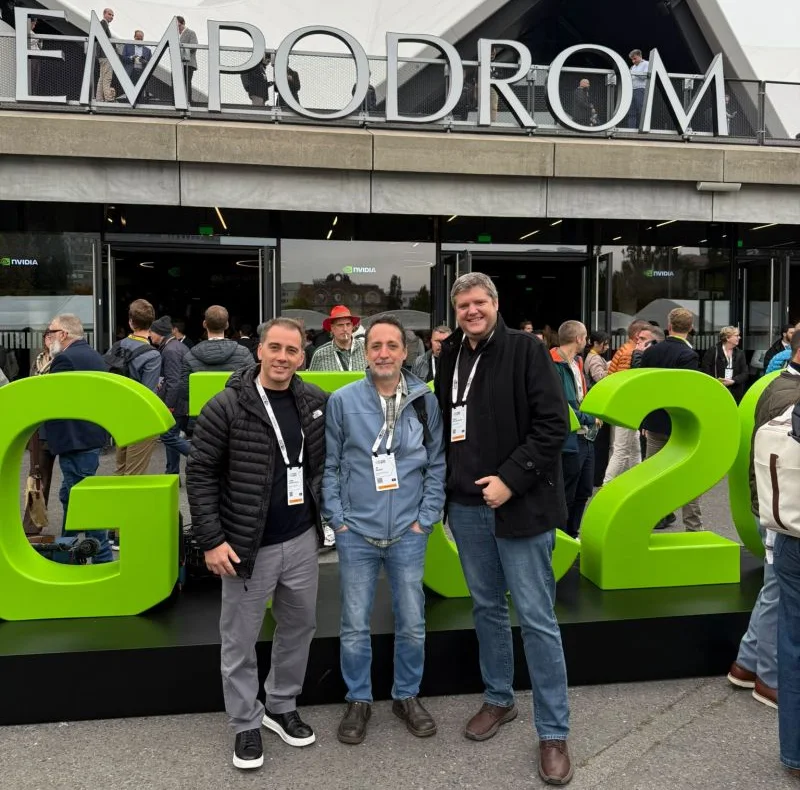
The Plain Concepts team outside the Tempodrom in Berlin, venue of the keynote.
NVIDIA’s European conference ran from 20 to 22 October at STATION-Berlin, with more than a hundred technical sessions, developer workshops on the first day and Huang’s keynote at the Tempodrom on Wednesday 21 October. Huang opened by committing close to $10 billion to the European technology ecosystem and spent much of his talk explaining how to move from models that answer questions to agents that carry out tasks on a company’s real data.
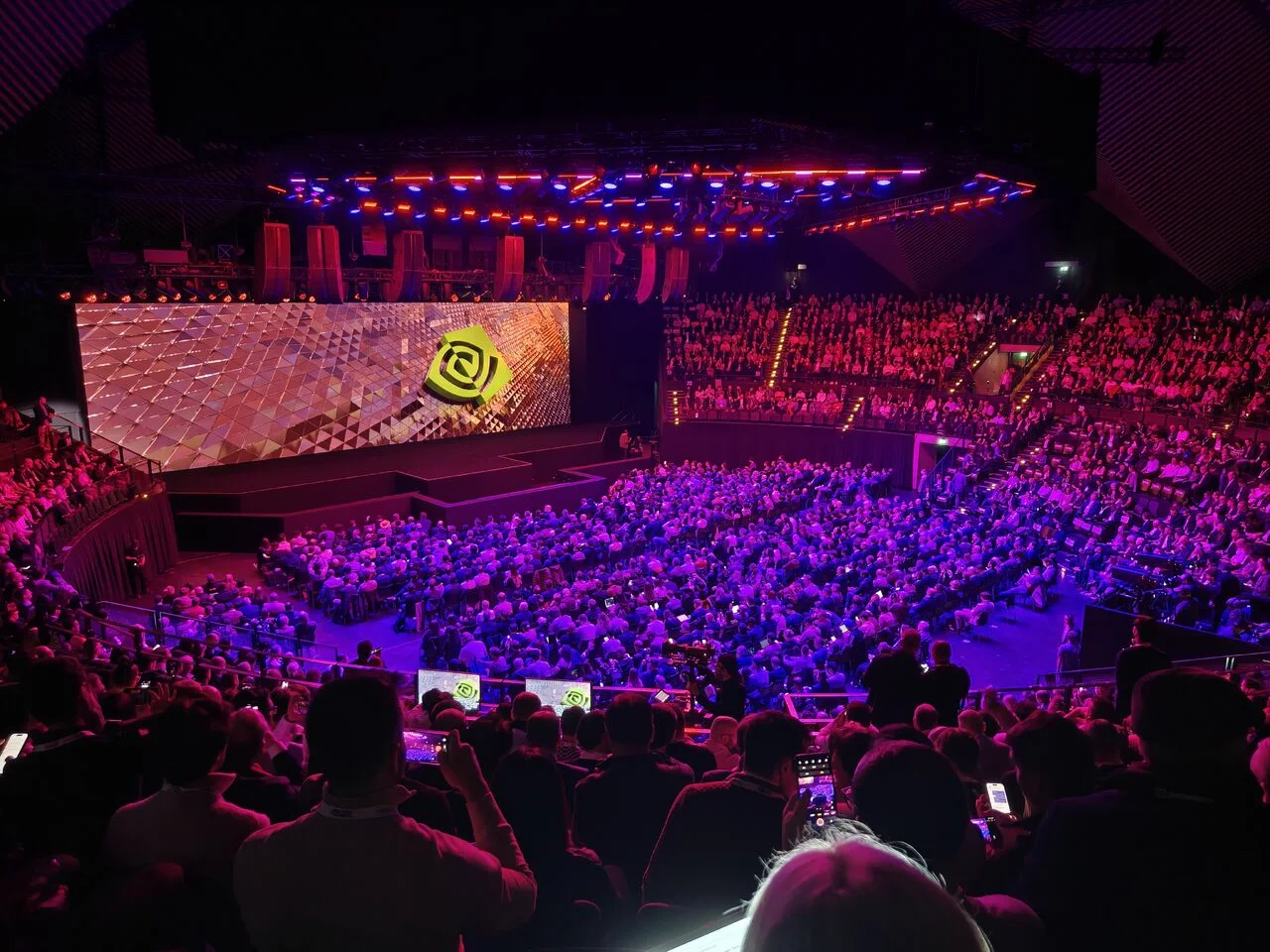
The Tempodrom, packed minutes before Jensen Huang’s keynote.
The topics covered at GTC Berlin 2026 included:
NVIDIA cuts the time to deploy AI factories
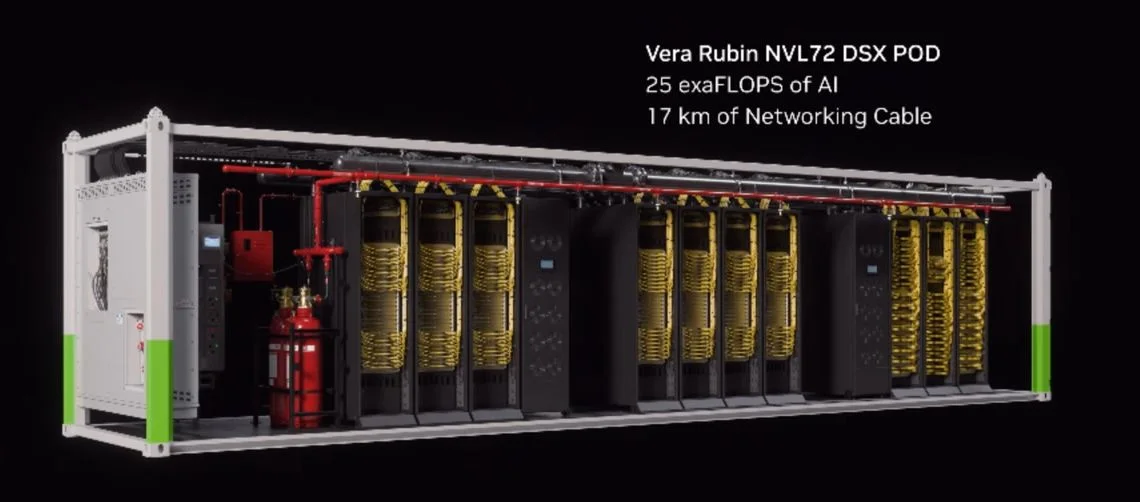
Vera Rubin NVL72 DSX POD, with 25 exaflops of AI and 17 km of networking cable in a single container. Image: NVIDIA.
Huang confirmed that Vera Rubin, the new generation of NVIDIA’s computing platform, is now in full production, and introduced DSX POD, a reference design that lets NVIDIA’s partners build AI factories in modular containers that arrive on site already integrated and validated. According to the company, once power and cooling are in place, deployment drops from around six months to 14 days, while the DSX AI Factory platform delivers the same output with up to 30% less energy. NVIDIA also announced Minerva, an AIOps platform that brings infrastructure and workload telemetry together to provide end-to-end observability.
On the cloud side, Google Cloud announced general availability of its A5X instances with Vera Rubin NVL72 in the coming weeks, with expansion into Europe planned, and providers such as Nebius and Nscale will adopt the Vera CPU in their new infrastructure. For a company that is not going to build its own data centre, the practical consequence is that the most advanced compute will be available in European regions, which makes it easier to meet data residency requirements without giving up large models.
NVIDIA builds agent security into the design
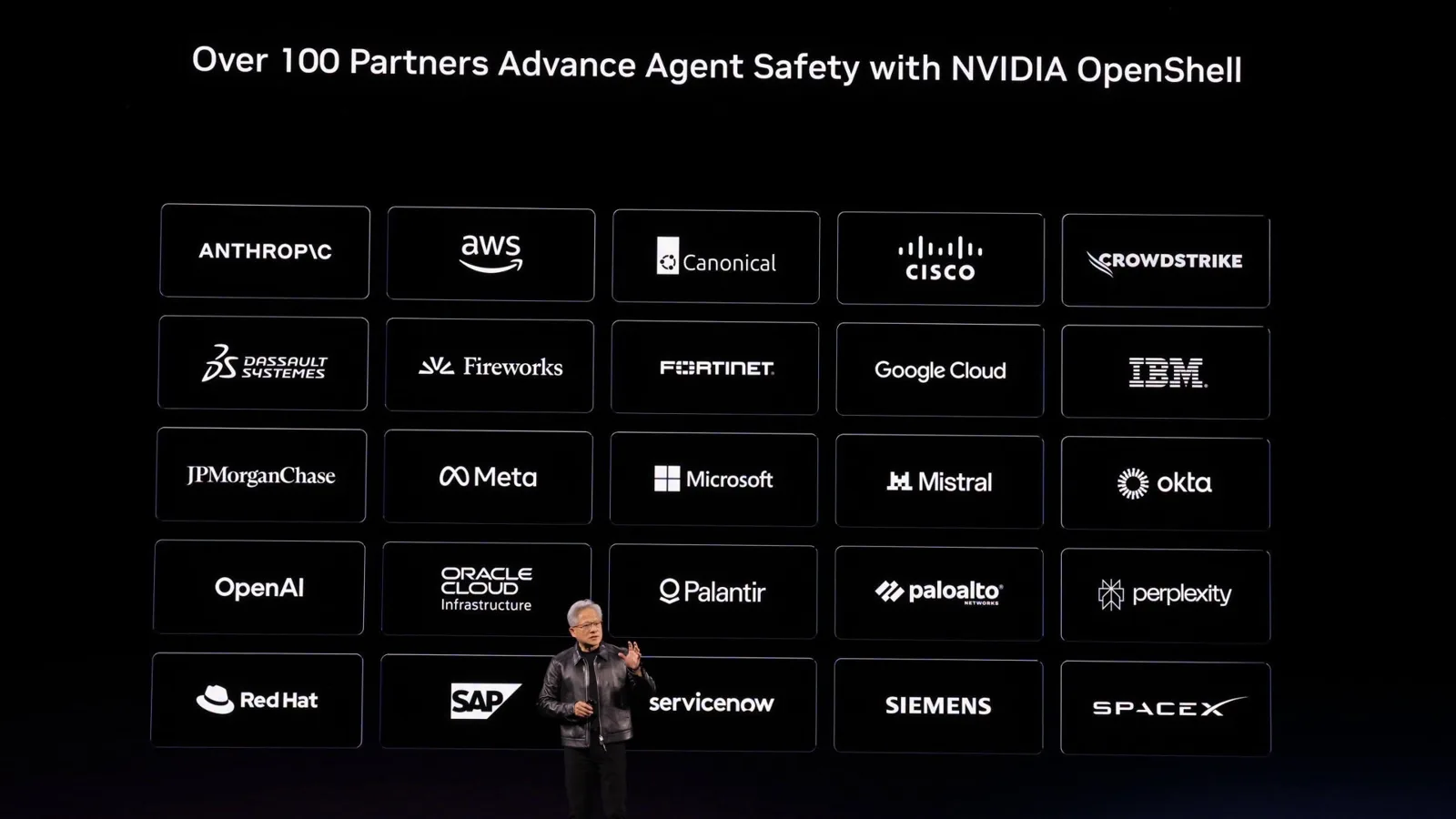
Huang presents the partners adopting OpenShell for agent safety. Photo: NVIDIA.
The announcement with the most relevance for enterprise projects was the OpenShell reference architecture for safe agents, built on an open-source runtime that applies policy controls and kernel-level sandboxing. Huang stressed that an agent’s privileges should be the minimum required, monitored and adjusted on every run, and NVIDIA extended its Agent Toolkit with tools to govern and supervise agents that work with corporate data. The set was completed by Agent Knowledge Foundation, a collection of models and libraries for connecting agents to documents and databases, which includes Nemotron tools for parsing, embeddings and reranking, along with the new Kumo model family for predictions on structured data.
The approach matches what we have seen when testing agents in our own lab, because once an agent can query an ERP or trigger actions in production systems, the main risk lies in the permissions it is given and in what it can do without human oversight. We explain this in more detail in our article on runtime security for AI agents, and the conclusion is the same one Huang put forward, namely that access control has to be designed from day one rather than added after the pilot.
Open models gain ground in Europe
NVIDIA presented new versions of its open model families, including Nemotron 3.5 in its Super VL and Bolt variants, Nemotron Retriever, Cosmos 3.5 for world models, Alpamayo 2 Edge for autonomous driving, BioNeMo for biology and Ising for quantum computing. The company publishes the models together with the data and scripts needed to reproduce them, so each organisation can post-train them on its own information and deploy the result on whichever infrastructure it chooses.
That approach fits several European announcements made during the week, such as projects with governments to use open models while keeping control of the data, the European Broadcasting Union (EBU) extending its sovereign framework with NVIDIA, and the Barcelona Supercomputing Center start-up programme, now open through NVIDIA Inception. For organisations with sensitive data, an open model that is fine-tuned and deployed in-house reduces dependence on a single provider, although it requires the engineering capacity to maintain it, which is why we keep working on options that lower that cost, such as our alliance with Multiverse Computing to bring compressed models into production.
Siemens shows physical AI at its Erlangen factory
Physical AI, meaning AI that perceives and acts on the real world through robots, sensors and simulation, had its most visible example at the Siemens factory in Erlangen, with around 1,000 production staff, where the two companies apply agents and digital twins to production planning. In the circuit board inspection project, the goal is to cut by up to 85% the manual effort needed to create inspection programmes, and Siemens also announced a €500 million investment in its technology campus in the city. NVIDIA released Factory Operations Blueprint (FOX) in early access, a template for building agents for plant management and visual inspection.
In robotics, NVIDIA presented Agile ONE SN, a reference humanoid based on Isaac GR00T with 31 degrees of freedom that will be available next year, and in healthcare Siemens Healthineers showed its work on AI-driven adaptive radiotherapy. Our Research team works with NVIDIA technology in 3D graphics, simulation and avatars, as in the latency comparison between LLMs and Audio2Face we published in August, and we see digital twins as the most direct way for industry to test these systems before touching a real production line.
Revolut and carmakers show production use cases
Revolut explained that it already runs PRAGMA, its own foundation model, in production, initially serving 80 million customers on Blackwell Ultra infrastructure and sized to triple that capacity. In the automotive sector, Volvo Cars will adopt NVIDIA’s Hyperion platform and Alpamayo stack, upcoming vehicles from Mercedes-Benz, Volkswagen, JLR and Volvo will be Hyperion-compatible, and companies such as Bolt, working with Lucid, and Einride showed level 3 and level 4 autonomous driving projects and robotaxi fleets.
These cases show that projects reaching production at scale share two traits, a well-defined use case with clear metrics and infrastructure sized to grow, which are also the criteria worth applying to prioritise any AI initiative before scaling it up.
RTX Spark puts a petaflop in a laptop
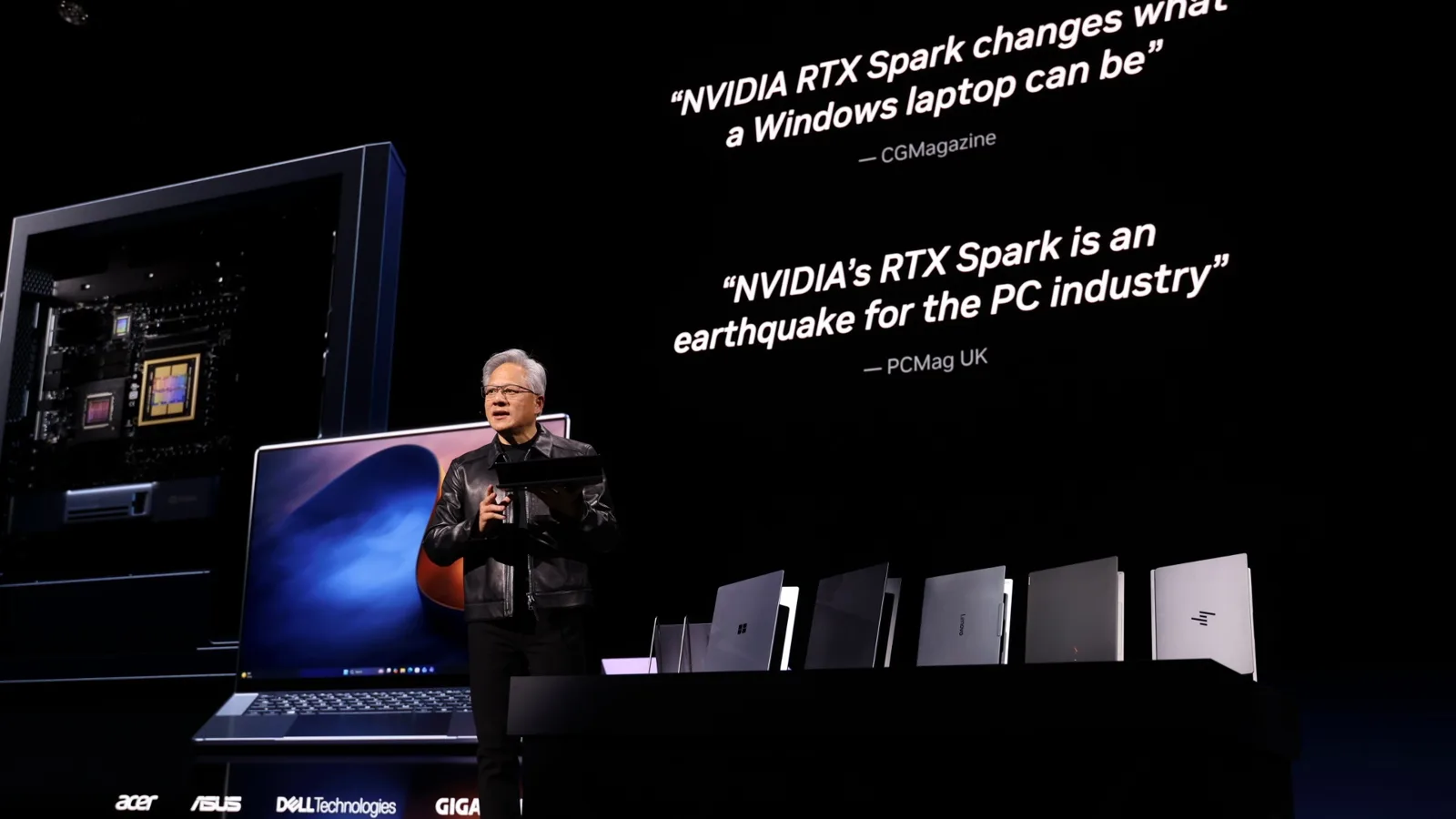
The first RTX Spark laptops on stage at the keynote. Photo: NVIDIA.
NVIDIA unveiled RTX Spark, a range of Windows laptops that deliver one petaflop of performance and up to 128 GB of unified memory, priced from $2,399 with models from ASUS, Dell, HP, Lenovo, Microsoft and MSI. Huang compared it with the DGX-1 that NVIDIA delivered to OpenAI in 2016 and also announced a Windows version of DGX Station from December.
For development teams, this local capacity makes it possible to prototype, fine-tune and evaluate models on sensitive data without it leaving the machine, although deployment at scale will still go through the cloud or a data centre.
What we took away from NVIDIA GTC Berlin 2026
The idea running through almost every session was that AI agents are moving beyond the demo stage and that, to do so safely, they need tightly scoped permissions, governed access to data and infrastructure the company can control, whether in the European cloud or on its own premises. For organisations that have been running pilots for months, the message is that the bottleneck now sits in integrating, securing and operating those agents.
The announcements are also worth reading carefully, because some of what was presented is available today, such as the Nemotron models or the cuDSS library, while other components, such as FOX or the Agile ONE SN humanoid, are in early access or will arrive next year. Telling one from the other is what lets a company invest in what already delivers value and plan calmly for what is still on the roadmap.
At Plain Concepts we help organisations with AI transformation and adoption, from prioritising use cases to integrating and evolving them in production, and we combine strategy, engineering and change management so that projects translate into measurable results. If you are considering how to bring agents or open models into your organisation, we can help you define the next steps.
Frequently asked questions about NVIDIA GTC Berlin 2026
From 20 to 22 October 2026 at STATION-Berlin, with Jensen Huang’s keynote on 21 October at the Tempodrom.
Vera Rubin in full production, the modular DSX POD design for AI factories, the OpenShell architecture for safe agents, new open Nemotron and Cosmos models, RTX Spark laptops and an investment of close to $10 billion in the European ecosystem.
A reference architecture for deploying AI agents with a zero-trust model, based on an open-source runtime with policy controls and kernel-level sandboxing.
Plain Concepts
We are a global IT professional services company


