

Juan G. Carmona
Software Architect at Plain Concepts


Agents need a plan
Spec-Driven Development (SDD) has been everywhere this year. The idea is simple enough: before an AI agent writes any code, we write a structured specification and a plan, and the agent builds from them. It took off in 2025, when AWS launched Kiro and GitHub released Spec Kit, and the amount of experimenting, real implementations and progress we've seen during 2026 has been staggering. If you've used GitHub Copilot's plan mode, you already know why it appeals. Complex tasks go much better when you agree on a design and split the work before asking the AI to code, and Spec Kit, OpenSpec and similar tools give us a more organised way to do exactly that. And yet plenty of engineers still reject SDD, often with good reason.
The complaint I hear most about SDD is that it produces too much text. I've seen repositories fill up with specs that nobody reads, let alone compares with what's already there. As software engineers, we want results, and tests that tell us whether something works. Comparing pages of repeated explanations just becomes another job, and much of that text ends up as noise.
A delivery spec gives us a design and a plan for a particular change. It helps us understand the work and helps the AI implement it at that point in time. But the product keeps changing. If an agent follows an old plan as though it were current, we can end up implementing something we already decided to change.
It reminds me of a courthouse archive. Hundreds of cases, some filling several binders, with amendments and older versions mixed in together. Finding the right folder is the easy part. Someone still has to work out which of those documents actually apply.
A repository full of delivery specs can leave us doing the same work. OpenSpec separates current specifications from archived changes, but the team still has to keep repeated product definitions consistent.
A product definition we could reuse
We've worked through this problem in several client projects at Plain Concepts, so let me explain it with a fictional online shop. Its refund policy allows 30 days from delivery. But the support-screen spec says “30 days from purchase”, and the email reminder says “one month after delivery”. Each feature could pass its own tests and still give the customer a different answer.
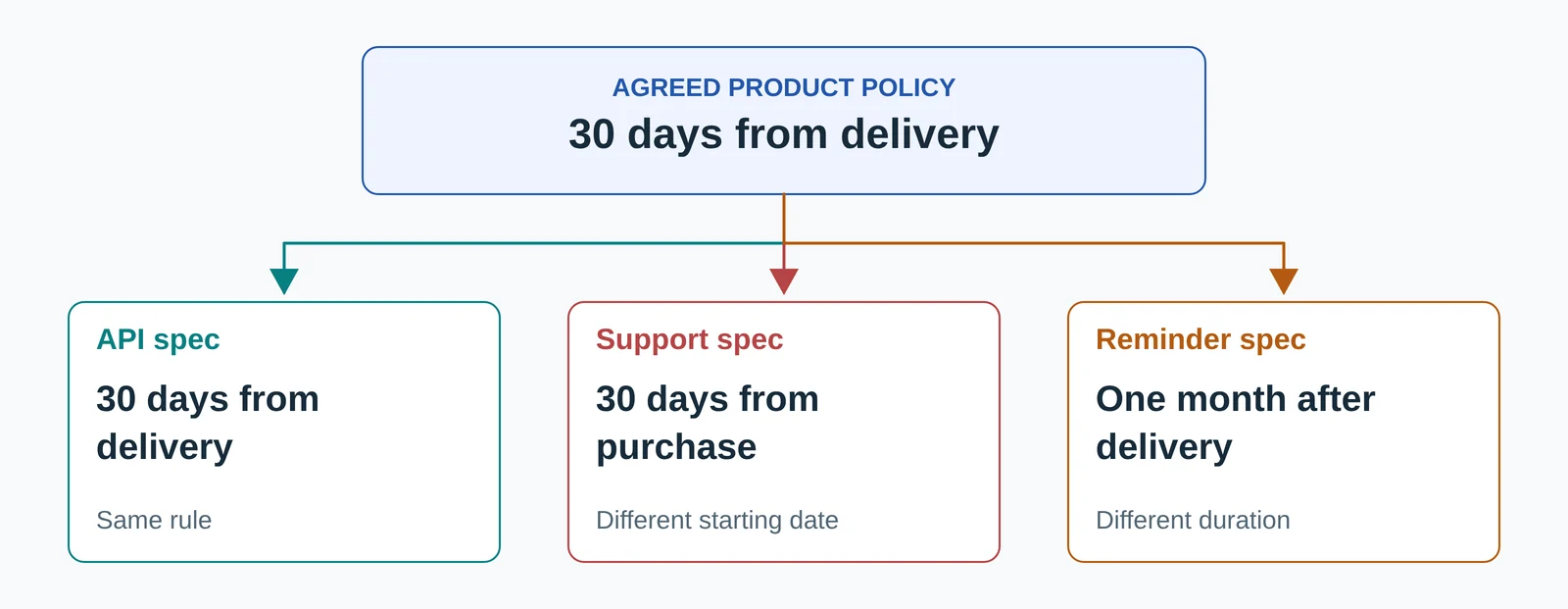
During refinement, we started asking the AI to organise our conversations into familiar artifacts: actors, use cases, user journeys, business rules and requirements. Each had a small Markdown document and a short identifier, and we told the AI to reuse those definitions when planning a feature. In the shop, every feature involving refunds would refer to the same rule. We kept updating the definitions as we learned more and the backlog changed, and it worked, both in proofs of concept and in projects that reached production. What I wanted next was a way to keep those connections as the product grew.
A summer spent formalising the approach
Around late April or May, I started looking for a way to formalise what we'd been doing. Keeping everything connected still took too much manual effort. I wanted to improve my own productivity and find a method others could use too, saving time and tokens as the product changed. So I worked on it over the summer, holidays included. I left some of my machines running and connected remotely, thinking things through on paper and sending small tasks to my own project repositories to try the ideas out. Those personal experiments became the first version of Product Definition as Code (PDaC).
Most of that learning, though, happened at Plain Concepts, during my time as chair of the DevEx chapter. Every single week, between 30 and 50 colleagues from across the company met at our roundtables to share what they were doing with AI: the tools and techniques they were using, the good and the bad, the caveats, the trade-offs and the pains. The amount we learned in those meetings was amazing. Some of those lessons were mine, and many more I could see in the eyes of the people around the table. That sharing made the difference, at least for me.
I learned a lot as a mentor, too. If you see the rise of AI in 2026 as a kind of crisis, our way through it was to learn. We put real effort into getting feedback from our engineers and giving it back, we set up mentorship programmes, and we launched plenty of other initiatives to share what we knew and keep evolving. I don't think many companies put so much attention, effort and resources into helping their people learn, and I've been lucky enough to be involved in most of those initiatives. All of that kept feeding back into our day-to-day work, and it also helped me shape PDaC and the tools I describe in this article.
AI helped me revisit use-case modelling, requirements traceability, domain modelling and configuration management, and work out how those established practices could support this effort. I used that existing work to record our agreed product intent in definitions we could trace and check, and an agent could follow. I've written about those sources in Where Product Definition as Code comes from. Because I'd developed all of this in my own time, I wanted to make it available as open source, so others could pick it apart and improve it. That also meant distinguishing what we'd already made work from hypotheses we still needed to test.
Following Domain-Driven Design (DDD), I organised domain terms around bounded contexts, so it was clear where each term's meaning applied. I brought that vocabulary together with actors and their journeys, use cases and the business rules governing them. Functional requirements described what the product had to do, and quality requirements set measurable expectations for how well it had to work. On top of that, constraints recorded the limits the solution had to respect. Even something as simple as a Structured Behaviour could record an expected outcome in Given / When / Then form and become the basis of an end-to-end test. Each of these definitions needed a home, with relationships between them, so we could follow a product decision through the artifacts that depended on it.
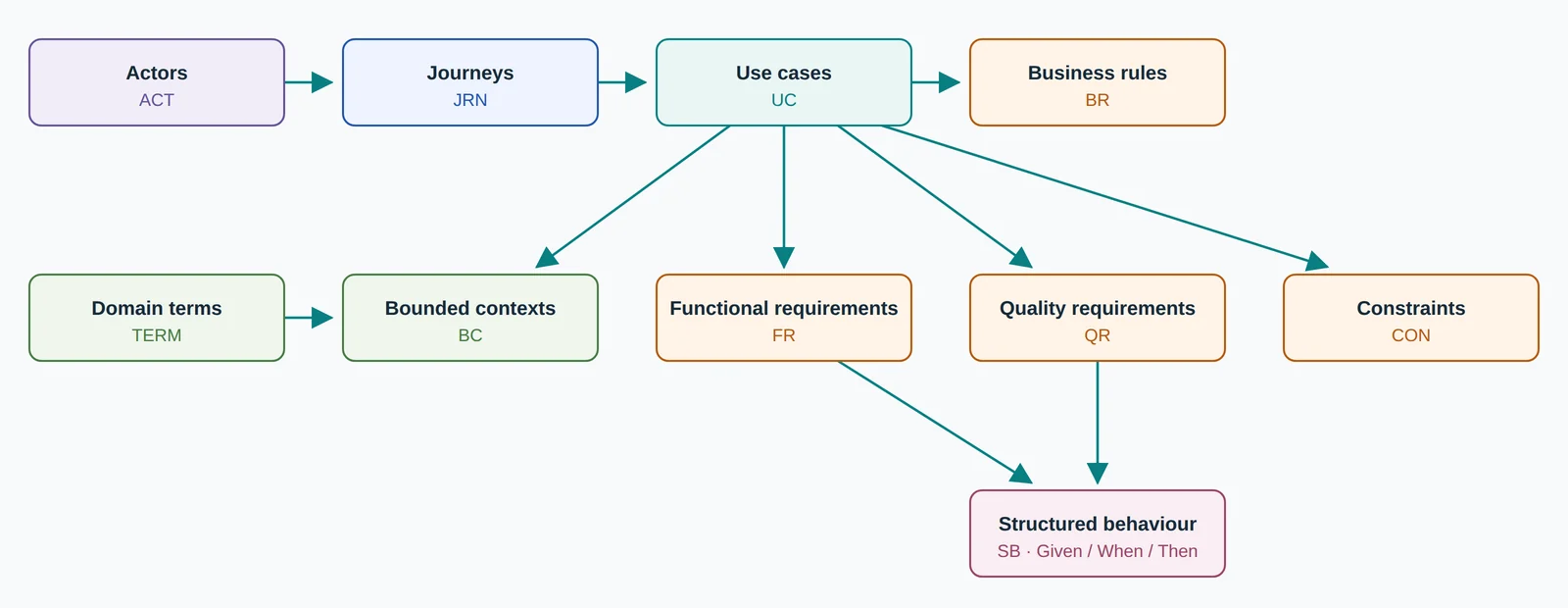
Each file also carried a status to distinguish a draft from an active definition or one we'd retired. Git kept the history, while the status told us which definitions belonged to the agreed product. The current v1alpha2 candidate also includes Domain Lifecycles, which describe the states an order can occupy, for example, and the transitions, triggers and rules that allow it to move between them.
From the start, I wanted product owners and people on the business side to be able to explore these connections without opening every Markdown file. I thought PDaC could become part of how we build software with AI, and I still do. That's why I built ProductShape as its first practical implementation, following its rules and developing Product Explorer so people could browse the same definition. If we use it to explore our shop, for example, we can follow the customer's refund request to its journey and the rule it must obey.
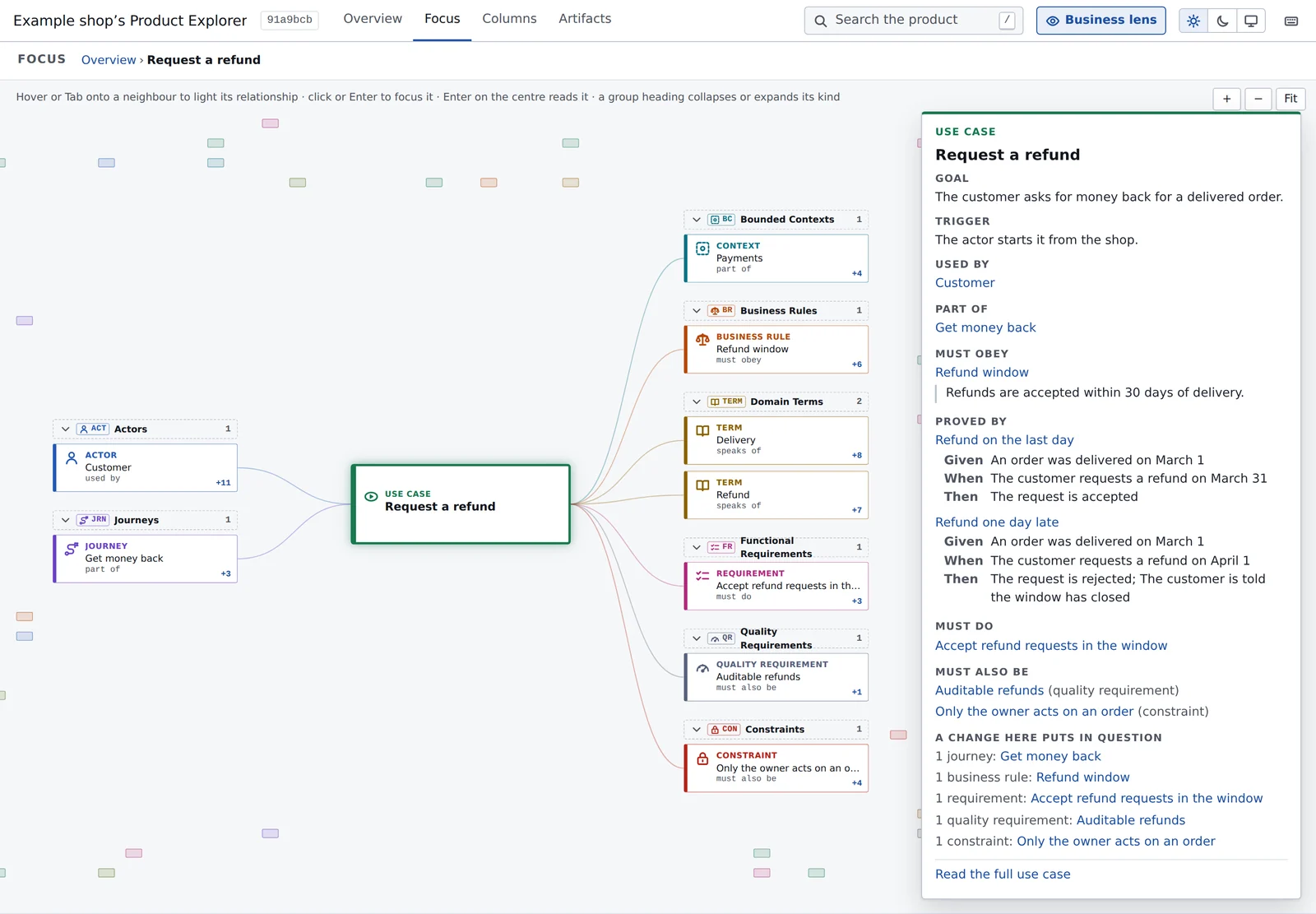
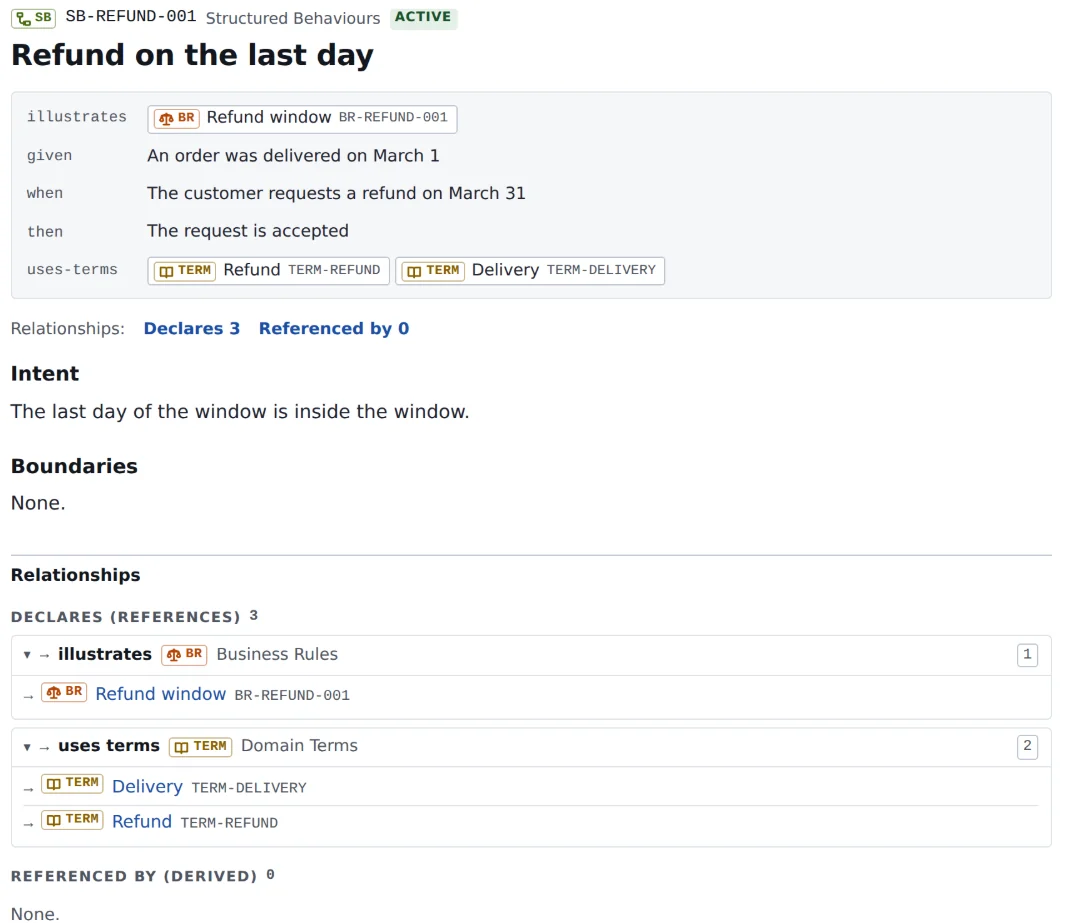
From that rule, we can open the boundary examples and review them with the business: a refund request on the last day is accepted, but one made the day after is rejected. Each behaviour has an ID that tests can cite.
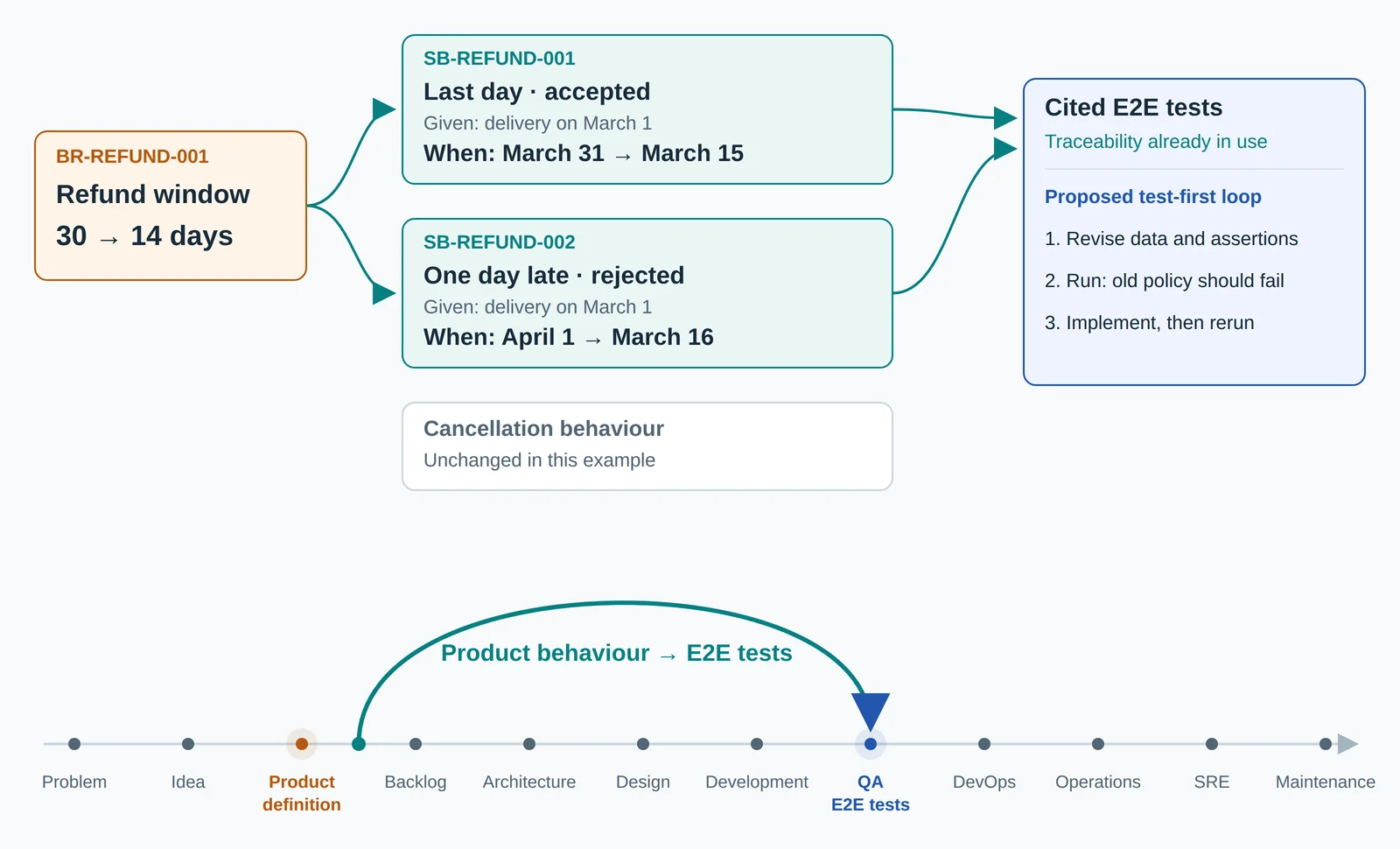
Now suppose the business agrees to reduce the refund window from 30 days to 14. We can follow the rule to the behaviours it affects, then use citations to find the tests that need updating. For a delivery on 1 March, the last accepted day moves to 15 March, and the first rejected day to 16 March. I've already made that traceability work, from a changed business rule to the affected Given / When / Then scenarios and the end-to-end tests that cite them. Finding those connections by hand used to take a huge amount of QA work. Once the relationships and citations are there, I can follow them whenever the rule changes.
We'd also debated end-to-end testing, Gherkin and the effort spent on tests versus documentation in the DevEx chapter. Here, a behaviour definition and a test that cites it give us a way to keep the expected outcome and its verification together. That made me wonder whether we could update the tests before implementing the change. A test expecting a request on 16 March to be rejected should fail against the existing 30-day policy. We could then change the implementation and run it again, doing end-to-end test-driven development. I haven't built that workflow. The traceability it would need is already in place, though.
Thousands of lines of architecture
After weeks of late nights and weekends, plus the odd hour squeezed out of my holidays, PDaC and ProductShape were beginning to pay off. Applying these techniques in my own projects and with client teams made it harder to ignore another problem, which was the amount of architecture documentation an agent had to read, and the confusion it could find there.
I'd seen huge architecture.md files with thousands of lines, alongside dozens of Architecture Decision Records (ADRs), the short documents Michael Nygard proposed back in 2011 to record each significant decision and its context. Some repositories required an ADR for practically every delivery spec. I understood that the intention was to give technical decisions a shared home, as we'd done with product definitions. But why should investigating a failed refund require reading the whole architecture and a long history of decisions? An ADR could explain why we'd chosen asynchronous refunds and what trade-offs we'd accepted, but to investigate a refund that never completed, we also needed to know which component owned its state and how the request got to the worker, not to mention where that worker ran. We needed to be able to find those explanations and keep them current as the system changed.
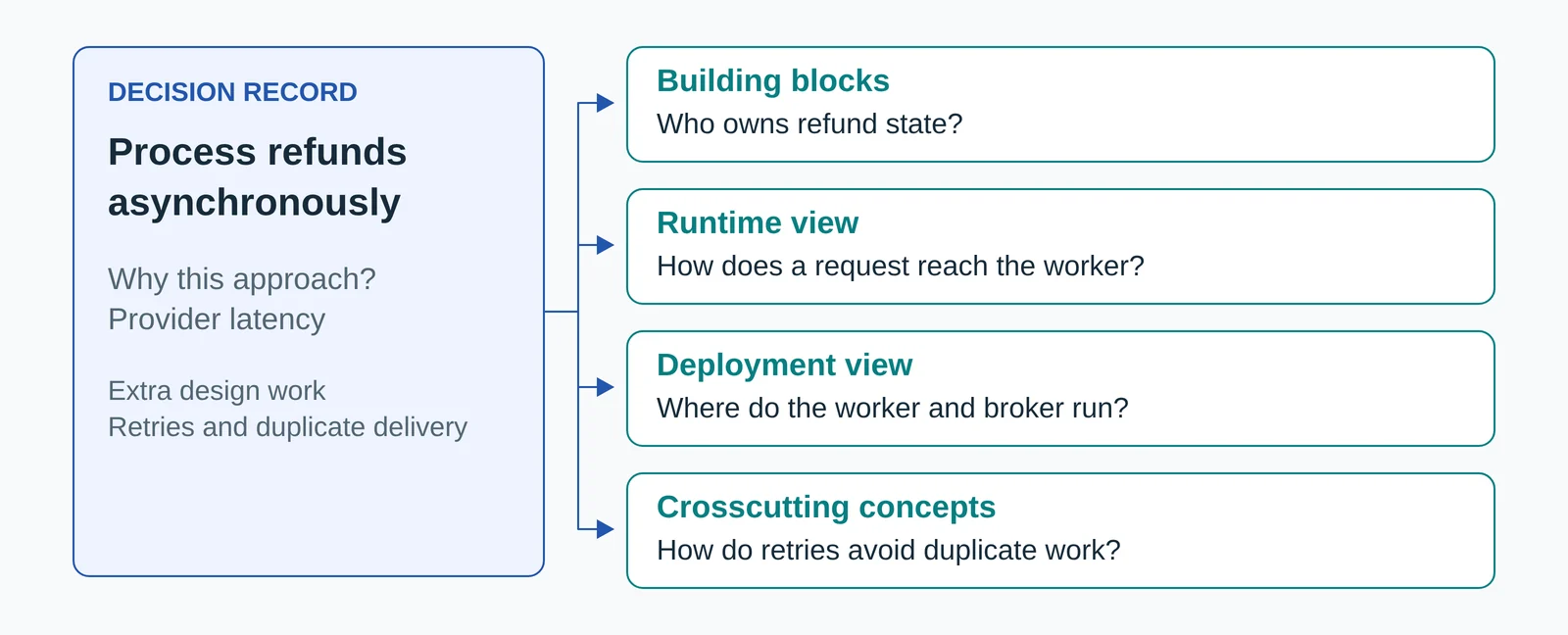
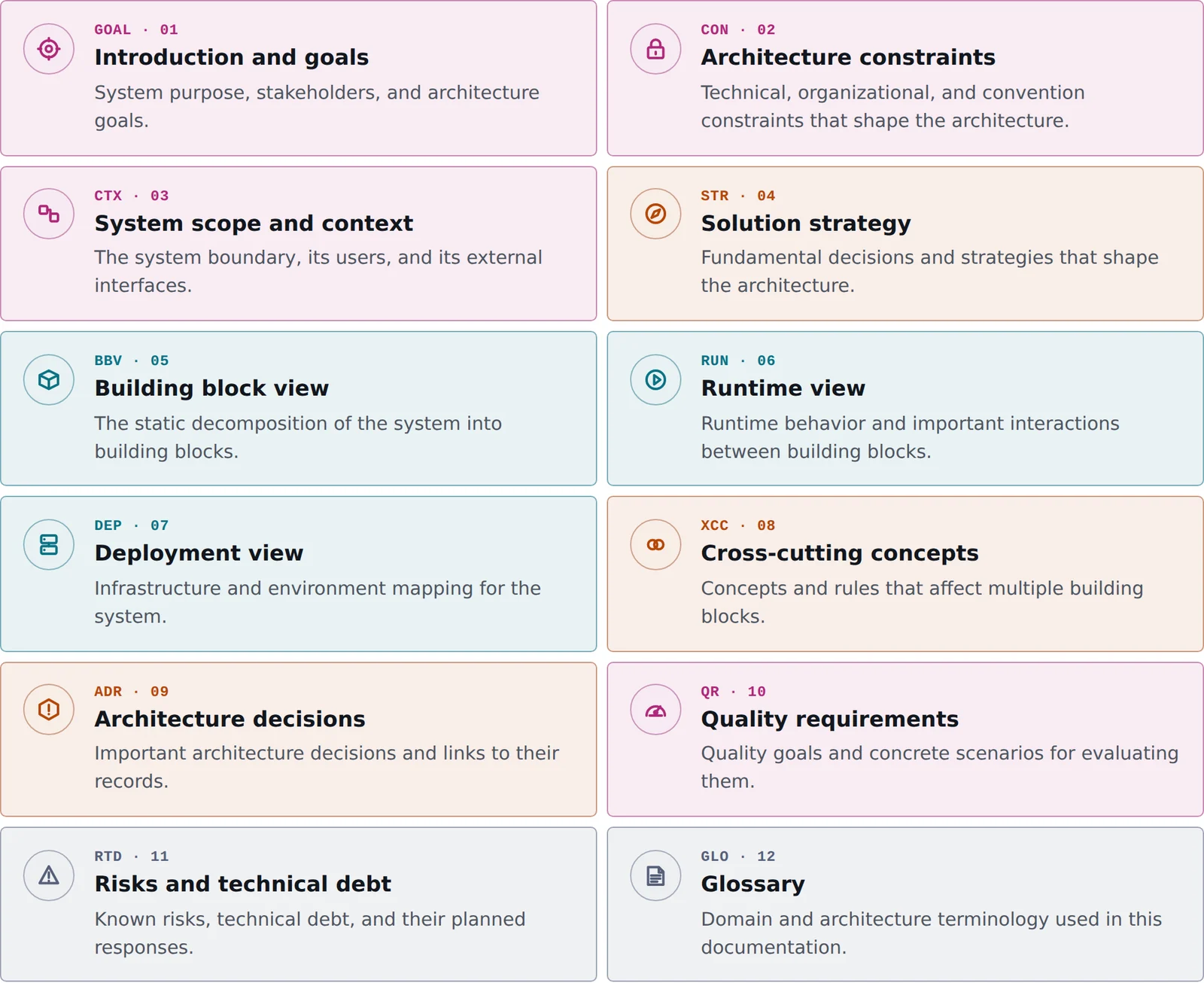
I chose arc42 because it was the architecture documentation framework I knew best. There are other approaches, including Views and Beyond, which organises documentation around architectural views, and C4, which focuses on diagrams at different levels of detail.
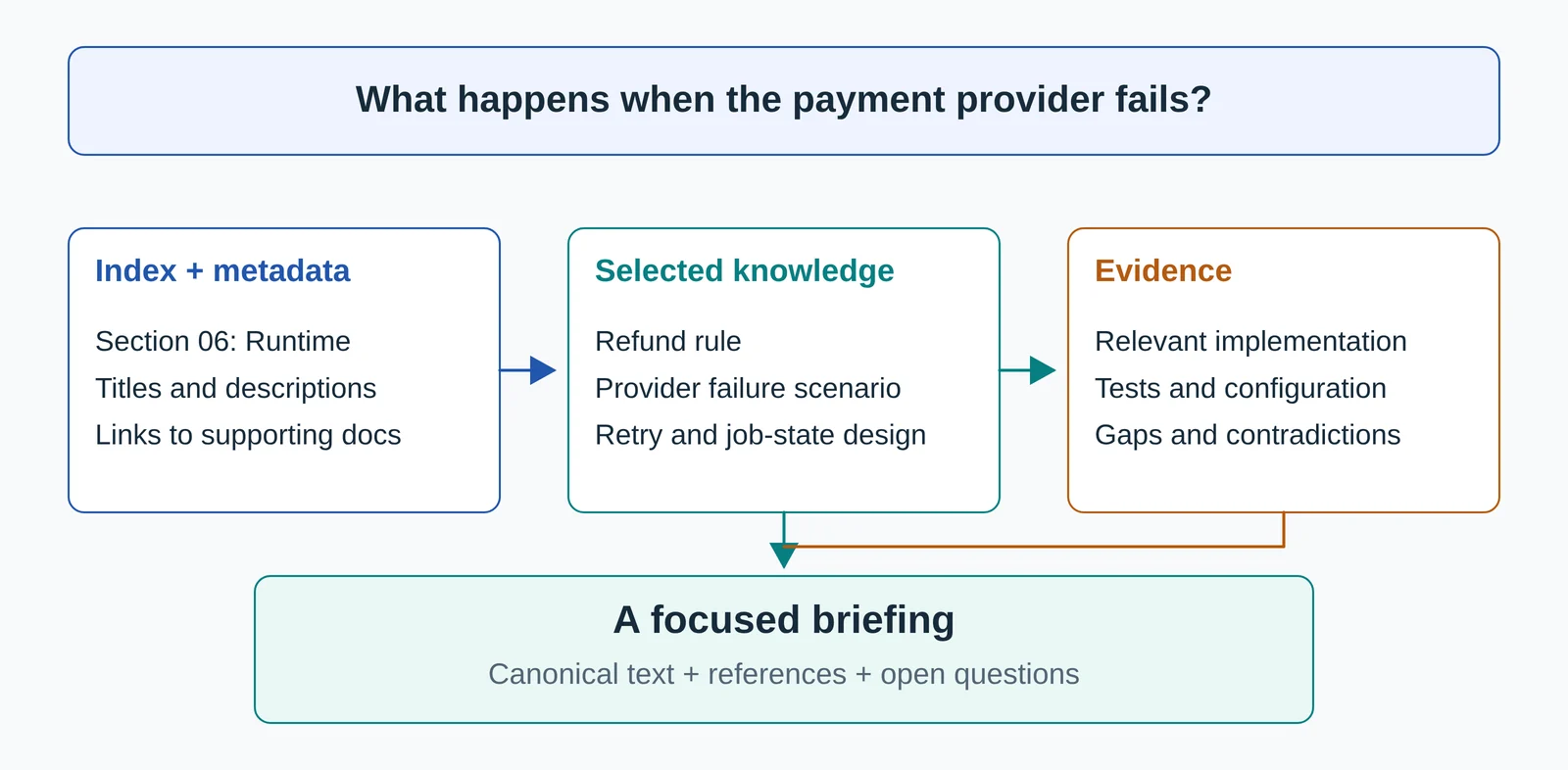
I started with a skill telling the agent to use arc42, then added templates. A single Markdown template grew into folders and files, with a README at each level explaining what belonged there. Frontmatter described each document, and rules helped keep the structure consistent. With that in place, an agent could start with an index and find the runtime scenario relevant to a payment-provider failure, then inspect the implementation and tests supporting it. We spent fewer tokens loading unrelated material, and had references to check against its answers.
A skill and templates still left too much setup to repeat, so I packaged them much as I had ProductShape. That became ArcShape: a CLI to install and manage the agents, skills and commands, check the documentation's structure and generate a static reader from the repository's Markdown files. Basically, I wanted the equivalent of Product Explorer for architecture, so people could browse the documents visually and follow their connections. The reader included diagrams too. We started with Mermaid and later added Archify, and now it supports both. People could explore the product and architecture while we kept their Markdown sources in Git alongside the code.
Keeping both sources useful
By then, I knew where I wanted our source of truth to live. The product definition held what we wanted the system to do. The architecture explained how it worked, and the constraints a change had to respect. Delivery specs could use both to plan the next piece of work. Design may belong here too, including the UI and UX decisions that shape how people use the product. I haven't pushed the approach that far, though a third source of truth wouldn't surprise me.
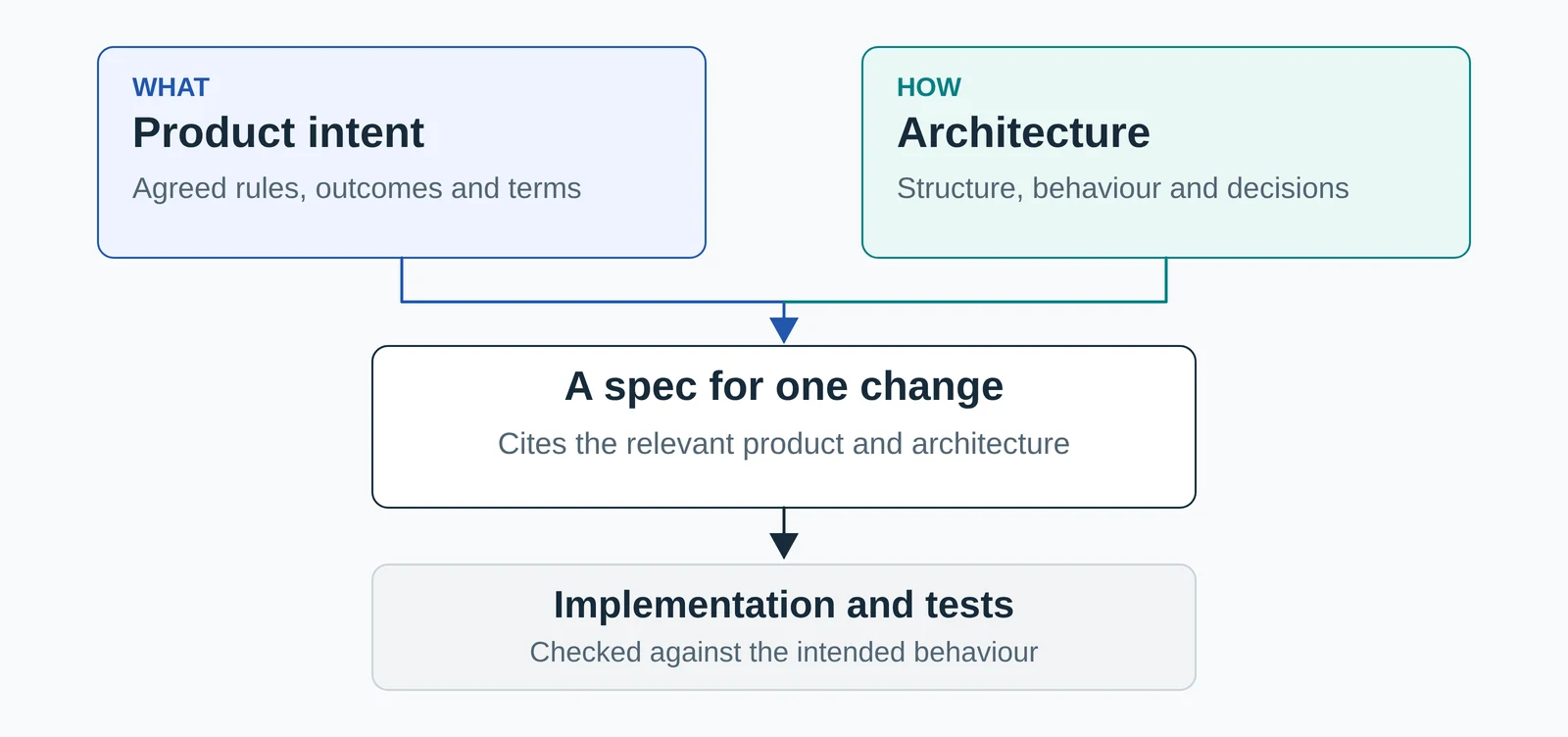
Implementation has to feed back into those definitions. If a business decision is missing, it goes back to the product owner. If the technical design changes, the architecture may need an update. Tests can check the behaviour we've described, and citations help us find what needs reviewing when it changes. We still have to investigate undocumented behaviour and check that the code does what we've agreed. Sometimes I wonder whether we could go as far as rebuilding the product if we lost all the source code. It would depend on how much the definitions and tests really cover and how many rules and exceptions are still buried in the implementation. And then there's the user experience we'd want to keep. Honestly, I don't know.
Recently, I was asked to estimate the work needed to migrate functionality from a poorly documented legacy system to a newer product. I installed the tools in a repository and worked through many rounds of investigation, going deeper into both systems each time. Frontier models helped with the reverse engineering, and the tools let me organise the findings as I went. I built up two detailed pictures of the products, covering their behaviour and business rules, architectures, database structures and DDL, and endpoints. With both side by side, I could map concepts from one to the other and compare how they worked. The migration project and its estimate came out of that.
The CTO told me he couldn't believe what one engineer had documented in a week, after years in which his engineering and architecture teams hadn't managed to put that knowledge together. That work also helped introduce these techniques in the company. I went on to teach other engineers how to use them, and some now teach others. Their questions also gave me more to investigate and improve in the tools. Since then, I've used these techniques in several more projects and keep refining them as I learn. These are the sources of truth and tools I use, and other engineers will have their own. I want to keep what we've learned about a system so we can use it when the next question or change comes along.
Back to the archive
My own work has changed along the way. As agents handle more of the implementation, I spend more time improving engineering processes we used to rush because we had to deliver. Much of it comes down to what the agents need to know and how we check their work, and then, when they get something wrong, what we should change.
I think this is how we make software engineering with AI reliable, or at least it's the best way I've found so far. We describe what we want in a structured way, and a small team of engineers maintains the product definition, architecture and rules the agents work from. Workflows take each task through implementation and verification, but the decisions and the quality criteria stay with the engineers. In Platform, the agentic platform we've built at Plain Concepts, we've already seen features delivered in a few hours by agents following these workflows, and the quality of that work is what gives me confidence. There's been a lot of talk about 2026 being the year of agents. For me, the workflows have mattered more, because they give those agents a process to follow that we can maintain and check.
So, if a team told me they were losing confidence in AI, that's where I'd start. Maybe they adopted SDD enthusiastically and got good results at first, then found the agent bringing back old decisions or building features that no longer fitted the product. I'd want to see what it was reading. Are those definitions still current? Does that plan belong to work that's already finished? Do the instructions even agree with each other?
We can plan every task and still leave the agent to reconcile contradictions we've never resolved ourselves. AI is just one more tool in our engineering process. It's still on us to explain what to build and how, and if all we give it is an archive of conflicting instructions, its mistakes shouldn't surprise anyone. I'd be back at that courthouse archive, trying to work out which documents still applied, and asking: is this mess your source of truth?
PDaC, ProductShape and ArcShape are open source. If you try them, break them or find something that doesn't fit how your team works, I'd love to hear about it.

